
Jetlag and Circadian Alignment | Sleep across lifespan | Insomnia | Sleep Apnea/CPAP | Sleepiness & Fatigue | Sleep Science | Video Series | External Resources
Knowledge Base & Media Library
Evidence-Based Sleep Science, Circadian Ergonomics & Rest Mechanics
Welcome to the HealthySleepCare Knowledge Base. Explore open-access video breakdowns, clinical summaries, and curated scientific literature designed to help individuals, healthcare practitioners, and organizational leaders master the physiology of rest.
Featured Video Series: HealthySleepCare Channel
Explore expert analysis and practical strategies directly from our video archive. Hosted by board-certified sleep specialist Dr. Parham Gharagozlou, these sessions translate complex sleep physiology into actionable guidance.
- 🎬 Shift Work & Circadian Rhythm Breakdown
How non-traditional schedules impact physiological recovery and strategies for shift ergonomics. - 🎬 Nightmares Decoded
Unraveling nocturnal cognitive processing, REM mechanics, and behavioral tricks to reduce night disruptions. - 🎬 Restless Legs Syndrome (RLS) Management
A deep dive into sensorimotor sleep disorders, iron metabolism, and non-pharmacological interventions.
👉 Subscribe to HealthySleepCare on YouTube
- Medical Disclaimer: The resources, videos, and articles provided in this Knowledge Base are strictly for educational and informational purposes. They do not constitute medical advice, diagnosis, or clinical treatment. For individualized medical care, please consult a qualified healthcare provider.
The Jet Lag & Travel Center: Circadian Alignment & Phase-Shifting
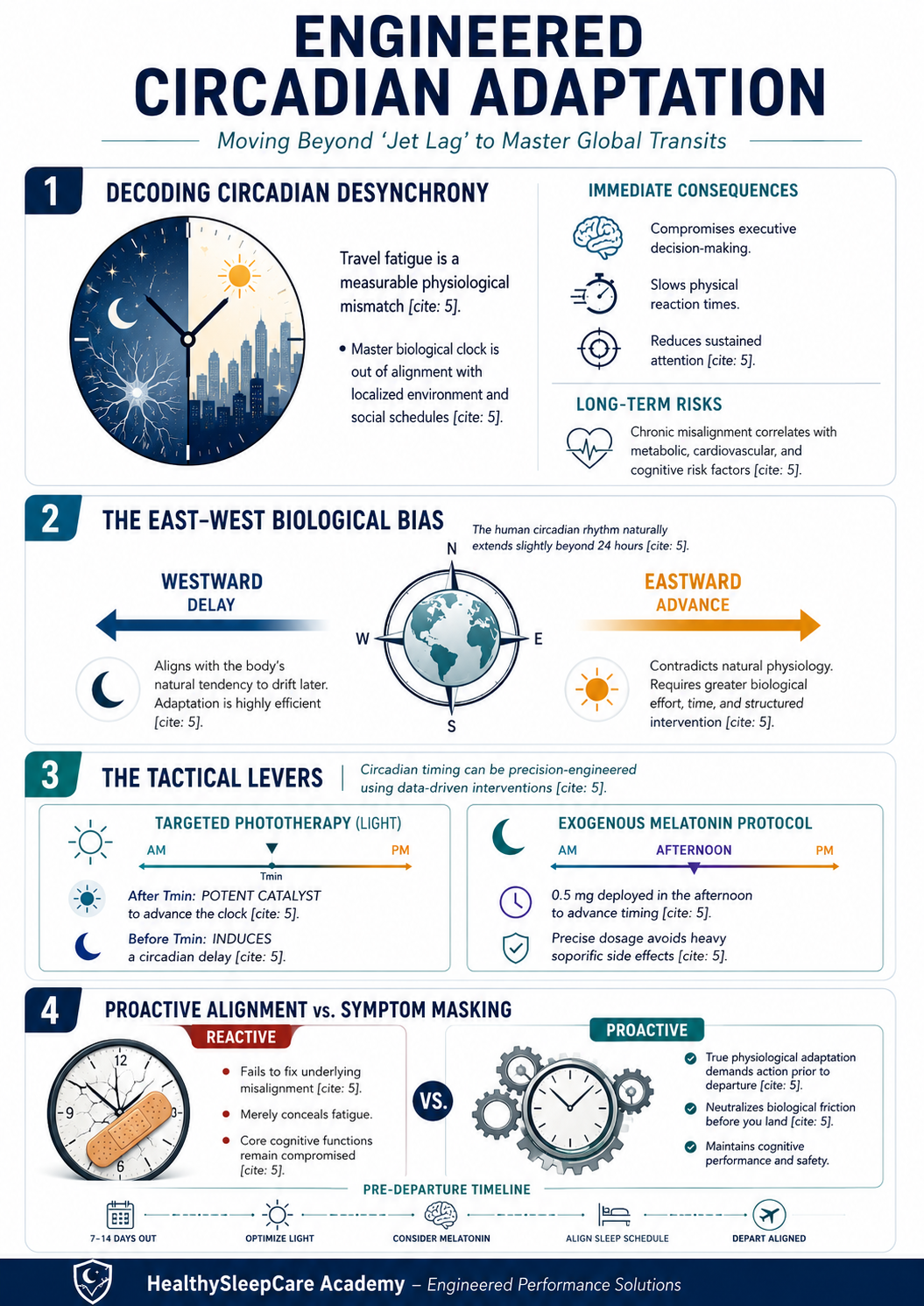
Circadian desynchrony (jet lag) is not merely general travel fatigue; it is a measurable physiological misalignment between the suprachiasmatic nucleus (the brain's master clock) and the local light-dark cycle of a new destination. Left unmanaged, it impairs sustained attention, reaction time, working memory, and prefrontal executive control.
The following evidence-based resources and protocols are separated by travel frequency to provide highly analytical, data-driven frameworks for adaptation.
Individuals & Occasional Travelers
Focus: Superimposing light and melatonin to force circadian adaptation using the Phase Response Curve (PRC).
Because the human endogenous circadian rhythm is slightly longer than 24 hours, eastward travel (requiring a phase advance) is mathematically and physiologically more difficult to adapt to than westward travel (requiring a phase delay).
Actionable Protocol: The Pre-Flight Phase Shift
Eastward Travel (Phase Advance): Begin shifting your schedule 2-3 days prior to departure. Advance your bedtime and wake time by 30–60 minutes per day. Critically, seek bright light immediately upon waking and strictly avoid light (using blue-blocking glasses or dim environments) 2-3 hours before your advanced bedtime.
Westward Travel (Phase Delay): Delay your sleep and wake times by 30–60 minutes per day prior to departure. Seek bright light in the late evening to push your circadian clock backward, and avoid bright morning light.
Data-Driven Reading List:
CDC Yellow Book: Jet Lag Disorder: The definitive public health standard for travel medicine, providing a strict clinical framework for distinguishing actual circadian desynchronization from general travel fatigue, including the specific timing of light exposure and avoidance.
How to Travel the World Without Jet Lag (PubMed/NLM): A highly analytical breakdown of the Phase Response Curve (PRC). This research mathematically maps how to superimpose light and melatonin to force circadian adaptation.
Note on Inconclusive Data: While the literature is highly decisive on the timing of exogenous melatonin relative to the Dim Light Melatonin Onset (DLMO), clinical data regarding the optimal dosage remains indecisive. Peer-reviewed studies demonstrate varying degrees of efficacy across a wide spectrum (from 0.5mg up to 5mg), indicating that strict timing on the PRC is significantly more critical than the absolute dose.
Frequent Flyers & Executive Professionals
Focus: Occupational exposure, chronic circadian disruption, and tactical scheduling for multi-leg travel.
Frequent, repeated transmeridian travel introduces chronic circadian misalignment. Over time, failure to manage this biological requirement determines whether the brain and body are ready to perform and creates an operational exposure that must be managed as a predictable safety hazard.
Actionable Protocol: The "Home-Base" vs. "Rapid Entrainment" Strategy
The "Home-Base" Strategy (Trips under 48-72 hours): For short executive turnarounds, do not attempt to shift your circadian clock. The biological cost of shifting is too high for a short duration. Maintain your home-time zone sleep hours, schedule high-cognitive-load meetings to align with your biological daytime, and strictly control light exposure at the destination to prevent accidental phase shifting.
The "Rapid Entrainment" Strategy (Trips over 72 hours): When local adaptation is necessary, aggressive phase-shifting must begin immediately upon boarding the aircraft.
Peripheral Clock Synchronization: The suprachiasmatic nucleus (master clock) is driven by light, but peripheral clocks (liver, digestion) are driven by food. Fasting during the flight and eating your first high-protein meal exactly at the destination's local breakfast time helps rapidly align these systems.
Aggressive Light/Dark Anchoring: Utilize the Phase Response Curve strictly. If you arrive in the morning, utilize high-lux daylight exposure immediately to suppress daytime melatonin. If you arrive at night, utilize heavy blue-light blocking and avoid airport terminal lighting to allow endogenous melatonin to rise.
Strategic Caffeine Utilization: Whether using Home-Base or Rapid Entrainment, utilize caffeine analytically to manage homeostatic sleep pressure (Process S). Because caffeine has a quarter-life of up to 10-12 hours, strictly terminate intake at least 8 hours before your target localized sleep window to prevent Process S from fighting circadian alignment (Process C).
Data-Driven Reading List:
NIOSH Aviation: Aircrew and Jet Lag: The National Institute for Occupational Safety and Health (NIOSH) assessment of jet lag. This removes jet lag from the "personal problem" category and frames it objectively as a systemic workplace exposure impacting cognitive execution and long-term health.
Managing Travel Fatigue and Jet Lag in Athletes (PubMed/NLM): A consensus statement providing meticulous, high-performance protocols for preserving sleep architecture, utilizing physical activity as a zeitgeber (time-giver), and mapping exact light exposure/avoidance for rapid re-alignment.
Federal Aviation Administration: Fatigue Risk Management Systems (FRMS): The federal regulatory framework for managing fatigue in continuous operations, proving that fatigue vulnerability across time zones can be quantified and managed using biomathematical models.
External Scientific Resources & Guidelines
For further academic reading and institutional research, we recommend these primary references:
- 📚 American Academy of Sleep Medicine (AASM) Patient & Provider Education
Clinical guidelines, consensus statements, and public sleep health information. - 🔬 NIH National Center on Sleep Disorders Research (NCSDR)
Federal research initiatives, clinical trials, and epidemiological sleep data. - 🏛️ CDC Sleep and Sleep Disorders Resource Hub
Public health data on sleep hygiene, shift work safety, and population-level sleep metrics.